STONES CROSSING, IN · Available 24/7 · (765) 436-6771

Frozen Pipe Burst Repair in Stones Crossing: Technical Steps

71caa1fd 19e8 4ca1 9c9c 4b0ea054519b

It usually happens around two in the morning. The temperature outside Stones Crossing drops into the single digits, the wind picks up, and somewhere behind a wall or under a crawl space, a copper line that has been holding pressure for fifteen years finally splits. By the time you hear the hiss or notice water creeping across the kitchen floor, hundreds of gallons may have already moved through your drywall, your subfloor, and the insulation under your first floor. That panicked walk down the hallway with a flashlight is the moment most Stones Crossing homeowners realize they have no idea where the main shutoff valve actually is.

At Stones Crossing Water Restoration, we have been answering those late-night calls since 2018, and the pattern rarely changes. A frozen pipe burst is not a slow leak you can mop up and forget about. It is a pressurized release of clean Category 1 water that turns into Category 2 within hours if the building materials stay saturated. This guide walks you through what to do in the first sixty minutes, what professional repair actually looks like under IICRC standards, and what the bill usually runs in central Indiana. If we cannot help with your situation, we will tell you directly.

Step-by-Step Frozen Pipe Burst Response

Step 1: Shut Off the Water Supply (0 to 3 minutes)

  1. Locate the main shutoff valve. In Stones Crossing homes, it is typically within 3 feet of where the service line enters the basement or crawlspace, often near the front foundation wall.
  2. Turn the valve clockwise until it stops. Ball valves require a 90 degree turn. Gate valves may need 6 to 8 full rotations.
  3. If the valve fails or will not seat, shut off at the curb stop using a 4 to 5 foot curb key, or call the Stones Crossing water utility for an emergency street shutoff.
  4. Open the lowest faucet in the home to relieve line pressure and drain residual water away from the break.
  5. Open one upper-level faucet as well to break vacuum and accelerate drain-down by 30 to 50 percent.
  6. Tag the valve position with a piece of tape and the time of shutoff. Adjusters and Stones Crossing Water Restoration technicians will ask for the exact minute flow was stopped.

Step 2: Cut Power to Affected Zones (3 to 6 minutes)

  1. At the main panel, switch off breakers feeding any room with standing water, wet ceilings, or saturated outlets.
  2. Do not enter standing water over 1 inch deep until power to that zone is confirmed off.
  3. Leave HVAC powered if the breaker is dry and clear. You will need airflow for drying in Step 6.
  4. If water is dripping from a ceiling-mounted light fixture or fan, kill the entire upstairs lighting circuit, not just the room circuit.
  5. Test outlets with a non-contact voltage tester before touching wet walls or pulling outlet covers.

Step 3: Locate and Isolate the Burst (6 to 15 minutes)

  1. Inspect exposed runs in unheated areas first: rim joists, garage walls, north-facing exterior walls, and crawlspaces under 40 degrees.
  2. Look for ice plugs, longitudinal splits 1 to 6 inches long, or fittings pushed off the line.
  3. Common failure points in Stones Crossing include hose bibs without frost-proof stems, washing machine supply lines on exterior walls, and copper elbows in attic runs above bedrooms.
  4. Wrap the break with a SharkBite cap, rubber and hose clamp sleeve, or pipe repair epoxy rated to 150 PSI as a temporary seal.
  5. If the break is on a PEX line, a SharkBite slip coupling rated for 1/2 inch or 3/4 inch resolves most splits in under 5 minutes without crimping tools.
  6. Photograph the failure point with a wide shot and a close-up. Insurance adjusters in Stones Crossing routinely request both.

Step 4: Document the Loss for the Claim (15 to 30 minutes)

  1. Capture 25 to 40 photos: every affected room, ceiling, wall cavity, flooring transition, and personal property pile.
  2. Record a 60 to 90 second video walkthrough narrating what you see.
  3. List damaged contents in a spreadsheet with item, age, and replacement cost.
  4. Save the temperature reading from the night of the freeze. NOAA data for Stones Crossing is admissible.
  5. Note wind chill values as well. Sustained wind chills under 10 degrees are a recognized trigger for sidewall pipe freezes.
  6. Call your carrier and request a claim number before cleanup begins. Reference our burst pipe water damage immediate steps and repair cost guide for the exact language to use.

Step 5: Extract Standing Water (30 to 120 minutes)

  1. Remove water over 0.25 inches with a truck-mounted or portable extractor rated 100 to 220 PSI.
  2. For basements, expect 1 to 3 hours of extraction per 500 square feet of saturation.
  3. Pull baseboards in affected rooms and drill 2 inch weep holes every 16 inches in drywall that shows wicking above 16 inches.
  4. Lift area rugs, pad, and unattached flooring. Most carpet pad in Stones Crossing losses is non-salvageable in Category 1 events after 48 hours.
  5. For deep basement saturation, see the Stones Crossing Water Restoration basement flooding service page for scope and equipment specs.

Step 6: Establish Drying Conditions (Hours 2 to 72)

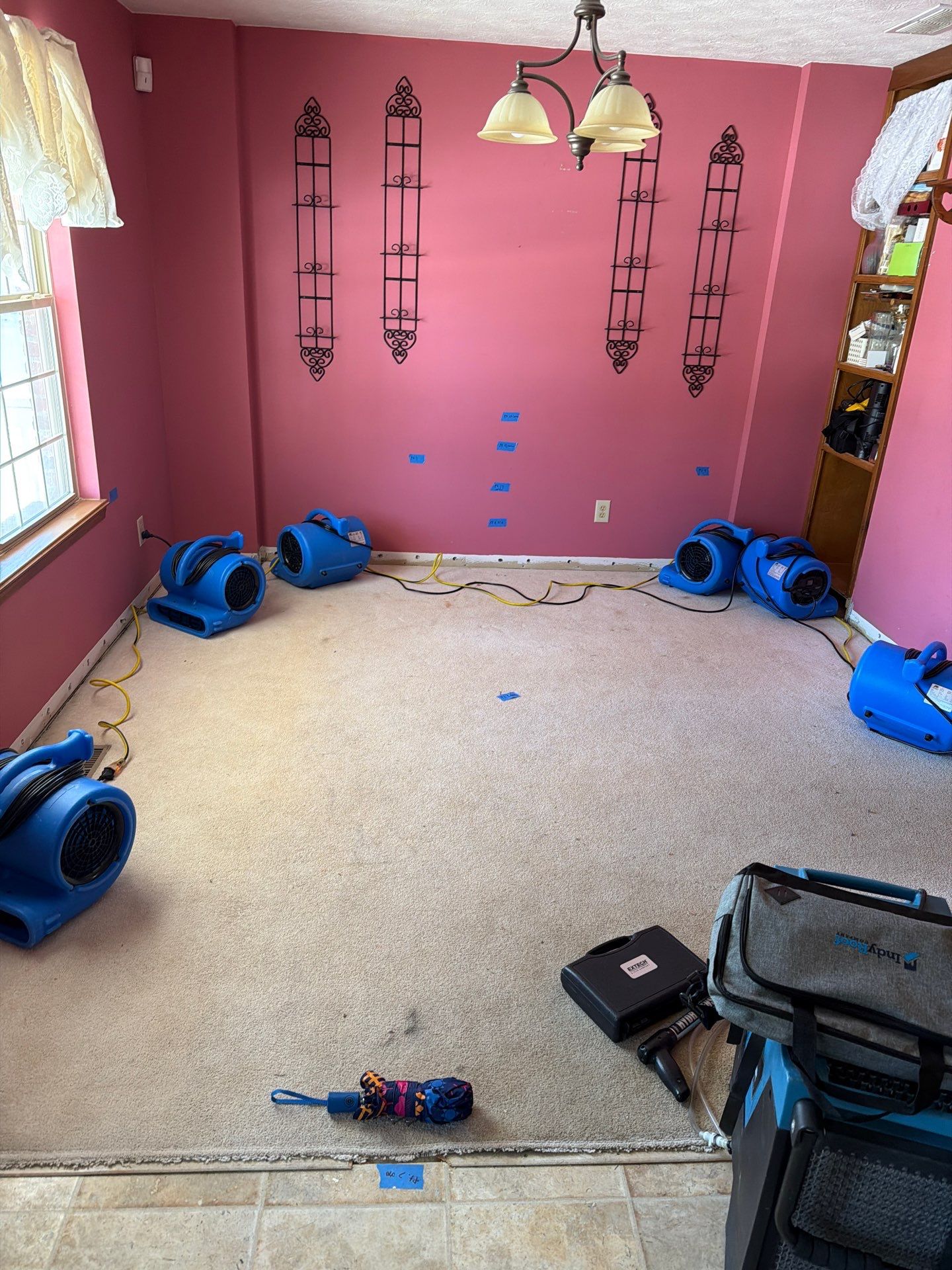
  1. Set air movers at 1 unit per 50 to 60 linear feet of wet wall, angled at 15 to 45 degrees.
  2. Place LGR dehumidifiers at 1 unit per 1,000 to 1,500 cubic feet of affected space.
  3. Target 30 to 40 percent relative humidity and a grain depression of 30 to 40 GPP between unaffected and drying air.
  4. Monitor moisture content daily with a pinless meter. Wood framing should reach 12 to 15 percent. Drywall should read under 1 percent on a Delmhorst scale.
  5. Maintain ambient temperature between 70 and 90 degrees. Drying stalls below 65.
  6. Log psychrometric readings every 12 to 24 hours: temperature, RH, GPP, and surface moisture at 3 to 5 marked points per room.

Step 7: Antimicrobial and Material Decisions (Day 1 to Day 3)

  1. Apply EPA-registered antimicrobial (such as Benefect or Shockwave) to all surfaces that contacted water.
  2. Cut drywall 2 inches above the visible water line. Standard tear-out heights are 2 feet, 4 feet, or full wall.
  3. Remove wet insulation. Fiberglass batts in Stones Crossing exterior walls lose 40 percent of their R-value after 24 hours wet.
  4. Closed-cell spray foam can be left in place if surface moisture reads under 16 percent and no delamination is visible.
  5. Evaluate hardwood for cupping. Refinishing is viable if cupping is under 1/8 inch and moisture content drops below 12 percent within 21 days.
  6. Engineered flooring with a wear layer under 3 mm is generally a full replacement after Category 1 saturation lasting more than 48 hours.

Step 8: Verify Dry Standard and Reconstruct (Day 3 to Day 14)

  1. Take a final moisture map. All readings must match unaffected baseline within 2 to 4 percentage points.
  2. Issue a Certificate of Completion documenting psychrometric logs.
  3. Reinstall insulation, hang and finish drywall, replace trim, and refinish or reinstall flooring.
  4. For total reconstruction costs by category, the water damage restoration cost breakdown covers line-item ranges from $1,200 to $18,000 in Stones Crossing.

Step 9: Prevent the Next Freeze (Day 14 and Beyond)

  1. Insulate any pipe within 4 feet of an exterior wall with 1/2 inch or 3/4 inch closed-cell foam sleeves rated to R-3 or better.
  2. Install self-regulating heat trace cable (3 to 5 watts per foot) on attic and crawlspace runs, with a thermostat set to activate at 38 degrees.
  3. Seal rim joist penetrations and exterior wall gaps with 2-part spray foam. A single 1/4 inch gap can drop pipe cavity temperature by 15 to 20 degrees on a 5 degree night.
  4. Add a smart leak sensor at the main shutoff. Automatic shutoff valves reduce average Stones Crossing burst pipe claims by 60 to 80 percent in Stones Crossing Water Restoration field data.
  5. Schedule an annual pre-winter inspection in October or early November. Address any pipe surface temperature under 45 degrees during a 20 degree outdoor test.

When You Need Someone in Stones Crossing Tonight

Frozen pipe damage gets worse every hour you wait, and the difference between a 3,000 dollar mitigation job and a 20,000 dollar reconstruction usually comes down to how fast you got water out of the materials. Stones Crossing Water Restoration answers the phone 24/7, dispatches IICRC-certified technicians across Stones Crossing and the surrounding area, and works directly with your insurance carrier so you are not chasing paperwork at midnight. If you are standing in water right now, call us. If your situation is something we cannot help with, we will point you to who can.

Frequently Asked Questions

How fast does Stones Crossing Water Restoration respond to a frozen pipe burst in Stones Crossing?

Our standard dispatch window in Stones Crossing and surrounding Central Indiana communities is 60 to 90 minutes for active emergencies, often faster during business hours. We arrive with extraction equipment and moisture meters on the first truck.

Will homeowners insurance cover a frozen pipe burst?

In most Stones Crossing policies, yes, provided you maintained heat in the home. Carriers may ask for thermostat records or utility usage. Stones Crossing Water Restoration prepares documentation that supports the claim, including moisture maps and daily drying logs.

How long does drying take after a frozen pipe burst?

Typical drying runs four to nine days depending on failure location, water volume, and affected materials. Attic and crawlspace bursts usually take longest because framing and insulation hold moisture deeper than drywall.

Can I just turn up the heat and dry it myself?

For very small bursts under 30 gallons with no hidden cavity damage, sometimes. For anything involving wall cavities, ceilings, or insulation, professional dehumidification is needed to prevent mold and structural rot. We will tell you directly which category you are in.

What does Stones Crossing Water Restoration charge to come out and assess?

Emergency assessments in Stones Crossing are free when you book mitigation, and we provide written scopes with moisture readings before any equipment is set. You see the plan and pricing before work begins.